Board
Board is a unified decision-making platform for finance, operations, and analytics teams. It combines business intelligence, corporate performance management (CPM), and planning into a single environment to support forecasting, financial consolidation, budgeting, and interactive reporting. Board is aimed at mid-market and enterprise organizations that need a single source of truth for planning and analytics across finance, sales, supply chain, and executive reporting.
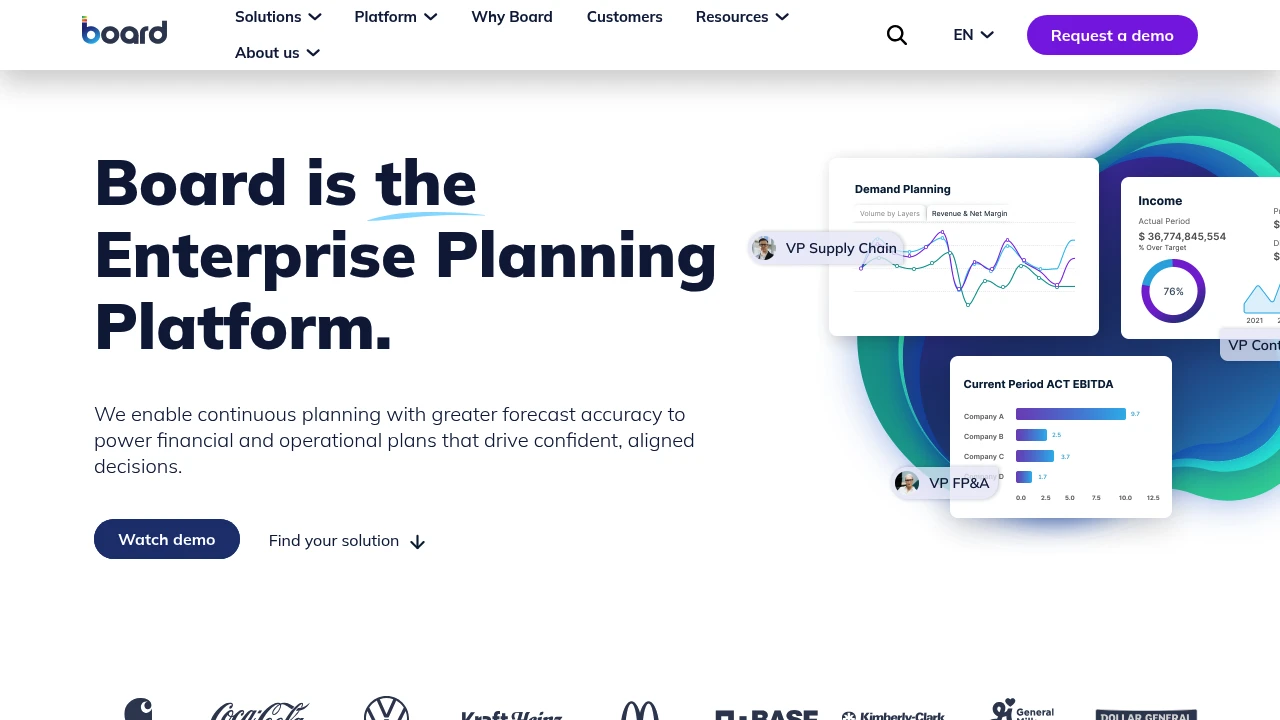
What is board
Board is an enterprise decision-making platform that merges analytics, planning, and reporting in one environment. The platform is designed to replace disconnected spreadsheets and multiple point solutions by providing a single model for data integration, multidimensional analysis, predictive planning, and management reporting. Typical users include finance teams performing budgeting and consolidation, operational teams running driver-based planning, and business analysts building interactive dashboards for executives.
Board's architecture combines an in-memory analytical engine with an application layer for planning workflows and a presentation layer for dashboards and ad hoc analysis. That combination lets teams move from static reports to scenario-driven planning with data refreshes and write-back capabilities. Board is available as on-premises deployment, private cloud, and hosted SaaS depending on customer needs and compliance requirements.
Key outcomes organizations use Board for include accelerated financial close and consolidation cycles, integrated sales and operational planning, and faster production of board-level reports that combine actuals, budgets and forecasts within the same model.
Board features
What does board do?
Board provides a set of modules and capabilities commonly bundled under analytics and corporate performance management. Core functional areas include data integration, multidimensional modeling, planning and budgeting workflows, reporting and dashboards, and predictive analytics. The platform supports write-back from planning interfaces so users can store scenarios and what-if inputs directly in the model.
On the data side, Board supports common connectors and ETL capabilities to bring in ERP, CRM, payroll and other transaction systems. Data modeling is multidimensional and can mix relational and OLAP-style structures for fast aggregation and slice-and-dice analysis. Users define hierarchies, calculations and allocations inside the model rather than managing those across separate tools.
The planning and workflow layer supports driver-based budgeting, rolling forecasts, long-range planning, and allocation engines. These workflows include approval routing, task assignment, version control and audit trails that are required for regulated financial processes. Visual planning interfaces, input templates and Excel-like grids are supported for both power users and business contributors.
The reporting layer offers interactive dashboards, standard financial statements, and pixel-perfect report generation for disclosures and board books. Built-in visualization tools, combined with scheduled publishing and export options (PDF, Excel), let teams produce recurring reports without manual aggregation. Board also provides ad hoc analysis capabilities so analysts can create new views or drill from summary to transaction detail.
Advanced features include embedded predictive analytics and machine learning functions for demand forecasting and scenario analysis, calculation-driven allocations for complex cost models, and integrated commentary and narrative blocks for board reporting. Security controls and row/column level restrictions are available to enforce data governance across users.
Board pricing
Board offers these pricing plans:
- Free Plan: $0/month with limited users and viewing-only dashboards for evaluation and small pilots
- Starter: $25/month per user when billed monthly; $20/month per user when billed annually ($240/year per user) with modeling, basic planning templates, and standard connectors
- Professional: $65/month per user when billed monthly; $55/month per user when billed annually ($660/year per user) including advanced planning, workflow automation, and predictive analytics modules
- Enterprise: Custom pricing with full feature set, advanced security, SLAs, and dedicated support
The pricing above reflects common licensing patterns for integrated CPM/BI platforms and is intended to give a practical comparison baseline. Check Board's current pricing plans for the latest rates and enterprise options.
How much is board per month
Board starts at $25/month per user for the Starter tier when billed monthly. Most organizations evaluate the Professional or Enterprise tiers for broader planning and consolidation features; those tiers commonly start around $65/month per user when billed monthly for named-user licenses. Many vendors in this category also offer bundled or concurrent user licenses that change effective per-user costs, so confirm license metrics during procurement.
How much is board per year
Board costs $240/year per user for the Starter plan when billed annually. The Professional plan typically costs around $660/year per user when billed annually under commonly used price structures for comparable platforms. Enterprise agreements are usually quoted annually with multi-year commitments and volume discounts.
How much is board in general
Board pricing ranges from $0 (free evaluation) to $65+/month per user. Entry-level pilots can be run with a free or low-cost Starter license, while production deployments for finance and planning commonly fall into the Professional or Enterprise tiers. Actual total cost of ownership depends on factors such as number of users, size of data models, required connectors, implementation services, and support level.
What is board used for
Board is used for integrated financial planning and analysis (FP&A), corporate consolidation, management reporting, and operational planning. Finance teams use Board to perform budget creation, driver-based forecasting, allocations, and statutory consolidation with workflow and approval controls. The system stores plan versions and provides audit trails which are necessary for regulatory and audit purposes.
Operational teams use Board to align sales, supply chain and workforce planning with financial targets. For example, sales planning can be combined with commission calculations and demand forecasting to produce unified profit plans. Supply chain planners can test inventory-policy scenarios and immediately see financial impacts.
Executives and management use Board for interactive reporting and scenario presentations. Board's dashboards can combine KPIs, charts, financial statements and narrative commentary in the same report, enabling faster decision cycles. The platform supports scheduled reports and ad hoc board books to streamline recurring board and executive reporting tasks.
Pros and cons of board
Board offers a consolidated environment for planning and analytics which reduces the need for multiple point solutions. Pros include unified data models, integrated planning and BI, and flexibility to support complex allocation and consolidation rules. The in-memory engine enables fast recalculation of large models and interactive scenario analysis.
On the negative side, Board deployments require careful model design and governance; inexperienced implementations can create large, hard-to-manage data structures. Upfront implementation and configuration costs can be significant, and many organizations engage certified implementation partners to accelerate rollout. Licensing and enterprise deployment costs may be higher than lightweight BI tools.
Operational considerations include the need for training for finance and business users to author models and design dashboards. IT involvement is typically required for integrations with ERPs, identity providers and secure data storage, although pre-built connectors reduce custom integration work.
Board free trial
Board typically offers a trial or sandbox environment to evaluate core features such as the modeling engine, dashboarding and basic planning templates. Trials are useful to verify how the platform handles your dimensionality (accounts, products, regions), connector compatibility, and sample data volumes. A pilot often includes a small, scoped use case such as budget consolidation or sales forecasting.
During a trial you should validate: data ingestion and mapping workflows, speed of recalculation with your model size, user experience for contributors entering budget inputs, and the ability to produce required statutory and management reports. Trials also allow you to test integration with Excel or export capabilities to meet existing reporting needs.
For an authoritative trial offering and the onboarding process, review Board's trial and evaluation guidance available on their site and discuss expected trial scope with a Board representative or certified partner.
Is board free
Yes, Board offers a free evaluation or pilot option for initial testing and proof of concept. The free option is limited in scale and intended for evaluation rather than production use. Pilots let teams exercise core functionality—data modeling, dashboards, and small-scale planning—before committing to a paid plan.
Board API
Board exposes programmatic interfaces to automate data loads, trigger model recalculations, export reports and integrate with external systems. Common API capabilities include REST endpoints for data transfer, authentication with OAuth or token-based methods, and job control endpoints to execute scheduled processes.
Integration points typically cover ETL import/export, user and role provisioning via SSO and SCIM-compatible interfaces, and connectors to common enterprise systems such as SAP, Oracle, Microsoft Dynamics, and Salesforce. The platform also supports direct interaction with Excel using add-ins or live connections so analysts can use familiar spreadsheets without breaking the central model.
For developer-oriented details and SDKs, consult Board's API documentation and developer resources to confirm supported endpoints, rate limits, and examples for common tasks like pushing actuals data or extracting consolidated reports. See the Board API and developer resources for current documentation and recommended integration patterns.
10 Board alternatives
Paid alternatives to board
- Anaplan — Cloud-based connected planning platform focused on large-scale finance, sales and supply chain planning with in-memory calculations and collaboration tools.
- Oracle EPM Cloud — Comprehensive enterprise performance management suite for financial consolidation, close, planning and reporting tightly integrated with Oracle ERP products.
- SAP BPC — Business planning and consolidation solution that integrates with SAP ERP environments and supports complex financial reporting and legal consolidation.
- Workday Adaptive Planning — Modern FP&A tool aimed at finance-driven planning and modeling with strong collaboration and ease of use for business users.
- OneStream — Unified platform for financial consolidation, planning and reporting that emphasizes lower TCO through a single data model and marketplace extensions.
- IBM Planning Analytics (TM1) — Enterprise planning and analytics engine providing high-speed multidimensional modeling known for flexible, user-driven analytic applications.
Open source alternatives to board
- Apache Superset — Open source BI platform for interactive dashboards and exploration; best suited for visualization and analytics but requires custom planning extensions for write-back workflows.
- Metabase — Lightweight open source analytics and dashboarding tool for quick visualizations and basic reporting; not a full CPM solution but useful for data exploration.
- Pandas / Jupyter ecosystems — Not a packaged CPM tool, but a toolset for analysts who want custom modeling, forecasting and reporting with full control; requires engineering resources to productionize.
- Grafana (with plugins) — Open source visualization platform that can be extended with data sources and plugins; suitable for operational dashboards but not for structured planning write-back without custom layers.
Frequently asked questions about Board
What is Board used for?
Board is used for integrated planning, analytics and reporting. Teams use Board to perform budgeting, forecasting, consolidation, and interactive reporting within a single data model. The platform supports finance, sales and operational planning use cases and is often adopted where linked planning and BI are required.
Does Board integrate with Excel?
Yes, Board supports Excel integration. Analysts can push and pull data between Board and Excel using add-ins or live connections so users can work with familiar spreadsheets without creating data silos. Excel integration is commonly used during budgeting seasons to allow contributors to enter inputs in Excel that write back to the central model.
How much does Board cost per user?
Board starts at $25/month per user for the Starter tier when billed monthly as a practical entry point. Production deployments for corporate planning typically use the Professional or Enterprise tiers with higher per-user or capacity-based pricing. Always confirm exact licensing metrics (named vs concurrent users) with a Board sales representative.
Is there a free version of Board?
Yes, Board provides a free evaluation or pilot option for short-term trials and proofs of concept. The free option is limited in scale and features and is intended for evaluation rather than full production use. Pilots allow teams to validate model performance and connector compatibility.
Can Board be used for financial consolidation?
Yes, Board supports statutory and management consolidation. It provides consolidation capabilities including intercompany elimination, currency translation, consolidation adjustments, audit trails and reporting tools suitable for group reporting. Those features are typically included in Professional or Enterprise deployments.
What integrations does Board offer?
Board includes connectors to ERPs, CRMs and cloud data sources. Typical integrations include SAP, Oracle, Microsoft Dynamics, Salesforce, data warehouses, and flat-file imports. Board also supports REST APIs, JDBC/ODBC connections and scheduled ETL jobs for automated data refreshes.
Does Board support forecasting and predictive analytics?
Yes, Board includes predictive analytics capabilities. Built-in statistical forecasting and machine learning functions can be used to generate demand forecasts, trend analysis and scenario projections that feed into planning workflows. These capabilities help teams create driver-based forecasts and evaluate scenario impacts.
How secure is Board?
Board provides enterprise-grade security controls. The platform includes role-based access control, user and group permissions, single sign-on (SSO) integration, and encryption for data in transit and at rest depending on deployment. For specific certifications and compliance details, review Board's security documentation.
Can I automate processes in Board?
Yes, automation is available for ETL, calculations and report publishing. Board supports scheduled jobs, automation scripts, and API-triggered processes to run data imports, refresh calculations, and publish reports. Workflow automation and notification rules help manage planning cycles and approvals.
How long does it take to implement Board?
Implementation time varies by scope and complexity. Small pilots or focused use cases can be implemented in a few weeks, while enterprise-wide rollouts covering consolidation, planning and multiple integrations commonly take several months. Implementation timelines depend on model complexity, data integration needs, and whether a certified partner is used.
board careers
Board maintains roles across product development, professional services, sales, and customer support. Openings often include positions for solution consultants, implementation consultants with CPM experience, product managers focused on analytics and BI, and engineers for cloud and integration work. The company hires people with domain knowledge in finance or technical backgrounds in data platforms.
For current career opportunities and job descriptions, check Board's corporate careers pages and LinkedIn listings to understand regional hiring and role requirements.
board affiliate
Board operates through a network of certified implementation partners and resellers that provide local consulting, configuration and training services. Affiliate and partner programs typically include partner certification, technical enablement, and joint go-to-market resources. Organizations choosing Board often work with partners for initial deployments to leverage domain specialists experienced in financial modeling and consolidation.
To learn about Board's partner ecosystem and become an affiliate, consult the partner information available on Board's website or contact their channel team for program terms and certification steps.
Where to find board reviews
Independent reviews for Board can be found on enterprise software review platforms, industry analyst reports, and case studies published by customers. Look for detailed evaluations on sites that cover BI and CPM solutions, and read vendor case studies that outline implementation scope, timelines and realized benefits. For the vendor's own success stories and customer references, consult Board's customer case study library and resources pages.
For up-to-date analyst coverage and user reviews, search enterprise software review sites and industry analyst reports that compare CPM and BI platforms.

Similar to Board